Leave Your Message
These days, China has really become a go-to place for sourcing all sorts of appliance parts, like springs for washers, fridges, ovens—you name it. When global buyers look for suppliers, they’re usually after consistent quality, fair prices, and reliable delivery. But honestly, picking the right supplier isn’t just about skimming through online catalogs and making a quick choice. It’s more involved than that.
A good supplier should get the ins and outs of spring design—things like wire types, heat treatment, and how well it handles fatigue. These details might seem small, but they really impact how appliances like washing machines or refrigerators perform. Plus, a trustworthy factory isn’t just going to throw product info at you. They should be able to chat about load requirements, how the parts hold up over time, surface finishes, and tolerance limits without any confusion. And it’s definitely a plus if they can send you samples, inspection reports, or proof of their production quality. Good communication is just as important as machine precision—nothing kills a project faster than misunderstandings.
Now, no supplier is perfect—no surprise there. That’s something buyers should keep in mind and be honest about. No amount of fancy website design can replace actually visiting the factory, testing samples, or reviewing clear quality agreements. It’s smart to ask for material certificates, check their process controls, see how they package products, and look over their records for dealing with issues. Doing factory audits or involving third-party inspectors before swinging into mass production can spot problems early on. These kinds of steps just make your buying decision a lot safer.
And here’s a biggie: when you’re dealing with suppliers in China, don’t just go for the cheapest deal. You want a partner who understands the risks involved in your application and will be honest and responsible if problems come up. Sometimes lead times shift or specs need tweaking—good suppliers will communicate about these things upfront. This article is all about helping buyers figure out how to evaluate a Chinese spring supplier based on technical skills, quality consistency, communication skills, and their ability to support you long-term. It’s all about practical advice, not empty promises.

An appliance spring supplier develops, produces, and verifies springs used inside household equipment. These parts support doors, latches, hinges, drums, valves, and control mechanisms. A Spring Door Spring, for example, must open smoothly and resist repeated tension without permanent deformation.
The supplier usually begins with material selection. Stainless steel suits humid washing environments, while high-carbon steel can provide stronger fatigue resistance. Wire diameter, coil pitch, hook shape, and working load require controlled measurement. According to Fortune Business Insights’ Home Appliances Market report, the global market reached about USD 720 billion in 2023. That scale increases demand for stable replacement components. Yet, large volume does not excuse weak traceability.
Reliable suppliers maintain lot records, spring-rate data, salt-spray results, and cycle testing. The U.S. Department of Energy’s residential clothes washer technical analysis uses hundreds of annual operating cycles when evaluating appliance performance. Springs therefore need testing beyond a simple visual check. In practical audits, engineers may inspect hook cracks after repeated compression, then compare free length against the drawing. Small errors matter. A door can sag, scrape, or fail to close.
Experience also exposes uncomfortable gaps. Some suppliers provide attractive samples but inconsistent production batches. Others report tensile strength without measuring fatigue life. Buyers should request material certificates, dimensional inspection records, and clear tolerance limits. ISO 9001 certification helps structure quality control, but it cannot replace product-specific testing. A capable supplier explains failures honestly, including results that need improvement.
| Evaluation Dimension | What an Appliance Spring Supplier Provides | Common Technical Data or Requirement | Why It Matters to Global Buyers | Recommended Evidence |
|---|---|---|---|---|
| Supplier Definition | A manufacturer or sourcing partner that designs, produces, tests, and ships springs used in household and commercial appliances. | Product scope may include compression, extension, torsion, conical, wire-form, and stamped springs. | Clarifies whether the supplier can support the complete process rather than only resell standard parts. | Product catalogue, process flow, engineering capabilities, and quality-management documentation. |
| Compression Springs | Helical springs designed to resist compressive loads and return components to their original position. | Typical design inputs include wire diameter, outside diameter, free length, active coils, solid height, spring rate, and operating load. | Frequently used in switches, valves, pumps, latches, controls, and appliance mechanisms. | Engineering drawing, load-versus-deflection report, and dimensional inspection record. |
| Extension Springs | Helical springs fitted with hooks, loops, or other end forms to resist tensile loads. | Important parameters include initial tension, extended length, hook geometry, wire diameter, and spring rate. | Suitable for doors, covers, dampers, linkages, and return mechanisms where pulling force is required. | Initial-tension test, hook-dimension report, and fatigue-test data where applicable. |
| Torsion Springs | Springs that store energy through angular deflection around a central axis. | Key inputs include torque, angular travel, leg length, coil diameter, winding direction, and number of coils. | Used in hinges, locks, handles, lids, and counterbalance mechanisms. | Torque-angle curve, winding-direction confirmation, and functional test results. |
| Common Spring Materials | Material selection based on load, temperature, corrosion exposure, fatigue life, and cost. | Carbon spring steel Stainless steel Music wire Alloy spring steel | Correct material choice helps maintain force stability, corrosion resistance, and service life. | Material certificate, chemical-composition report, hardness result, and traceability record. |
| Surface Protection | Finishing or coating processes used to reduce corrosion and improve appearance or handling. | Possible treatments include passivation, zinc plating, phosphate treatment, oiling, powder coating, and controlled heat treatment. | Appliances may be exposed to humidity, detergents, heat, condensation, and repeated cleaning cycles. | Coating specification, salt-spray report where required, and visual inspection standard. |
| Dimensional Accuracy | Control of the spring geometry and end forms against the approved drawing. | Typical checkpoints include wire diameter, coil diameter, free length, pitch, squareness, hook dimensions, and leg position. | Accurate dimensions support assembly fit, consistent force, and reliable appliance operation. | Inspection plan, calibrated measuring-equipment records, first-article report, and sampling results. |
| Mechanical Performance | Verification that the spring delivers the required force or torque throughout its operating range. | Tests can include load-deflection, torque-angle, permanent-set, fatigue, relaxation, and functional cycling tests. | Performance testing reduces the risk of noise, weak return action, deformation, and premature failure. | Test method, measured values, acceptance limits, and signed inspection report. |
| Temperature Capability | Assessment of whether the selected material and treatment remain stable in the appliance operating environment. | Evaluation should consider continuous temperature, short-term peak temperature, thermal cycling, and loss of load over time. | Important for ovens, heating systems, refrigeration equipment, motors, pumps, and other thermally stressed assemblies. | Material specification, heat-treatment records, and application-specific temperature test data. |
| Corrosion Resistance | Ability of the spring and its finish to withstand moisture, chemicals, and atmospheric exposure. | Testing may be selected according to the application, such as humidity exposure, salt spray, detergent contact, or chemical compatibility. | Corrosion can reduce wire diameter, increase friction, cause staining, and lead to sudden loss of strength. | Corrosion-test report, environmental specification, and coating-thickness measurement. |
| Manufacturing Process | Controlled production from wire preparation through forming, heat treatment, surface finishing, inspection, and packing. | Relevant processes include CNC coiling, automatic forming, stress relieving, grinding, shot peening, coating, and deburring. | A stable process improves repeatability for high-volume appliance programs. | Process flow chart, control plan, machine list, and process capability data. |
| Quality Management | A documented system for controlling incoming materials, production parameters, inspection, nonconformities, and corrective actions. | Useful controls include lot traceability, statistical sampling, gauge calibration, change control, and corrective-action procedures. | Global buyers need consistent quality across repeated shipments and production batches. | Quality certificate, internal audit records, inspection standards, and corrective-action samples. |
| Compliance Support | Technical documentation supporting the buyer’s product, material, environmental, and market requirements. | Documentation may include material declarations, restricted-substance information, packaging data, and product-specific test reports. | Clear documentation helps buyers complete supplier approval and market-access reviews. | Signed declarations, test reports from qualified laboratories, and controlled technical files. |
| Prototype and Customization | Engineering support for developing a spring from a drawing, sample, load requirement, or assembly problem. | Development stages commonly include requirement review, calculation, prototype production, testing, design approval, and pilot production. | Custom engineering is essential when the spring must fit a restricted space or meet a precise operating force. | Design-review records, prototype samples, revision-controlled drawings, and approval reports. |
| Packaging for Export | Protection against tangling, deformation, moisture, contamination, and mixing during storage and international transport. | Packaging may use compartmentalized cartons, sealed bags, corrosion protection, labels, batch identification, and pallet stabilization. | Proper packaging preserves spring geometry and simplifies receiving inspection at the destination. | Packaging specification, packing photographs, carton markings, and batch traceability details. |
| Global Buyer Selection Criteria | A structured method for comparing potential suppliers beyond unit price. | Consider technical capability, quality consistency, material traceability, communication, tooling ownership, delivery performance, and total landed cost. | The lowest quoted price may create higher costs through defects, delays, rework, or line stoppages. | Supplier questionnaire, sample approval, process audit, reference documentation, and a signed quality agreement. |
The global battery industry is expanding rapidly as portable electronics, smart devices, and compact equipment continue to grow. Grand View Research reports that the global battery market was valued at more than USD 130 billion in 2023, while Mordor Intelligence projects a double-digit compound annual growth rate in the coming years. This development is increasing demand for dependable AAA battery connectors, particularly components that support high-volume assembly, stable electrical contact, and long service life.
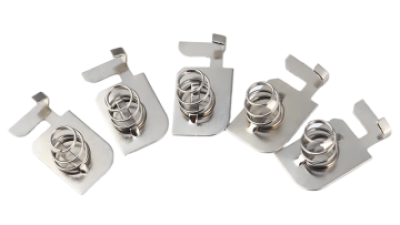
Our premium AAA battery contact springs are manufactured in China through fully automated production lines, delivering a capacity of over 2 million sets per day. A specialized bridge-riveting process permanently secures each spring to improve mechanical stability and reduce the risk of detachment during assembly or use. Both vertical and flat configurations are available for different product structures, with excellent solderability for efficient integration into battery compartments and electronic devices. Each connector also passes a rigorous 24-hour salt spray test, helping meet demanding durability requirements in consumer electronics, instrumentation, and other battery-powered applications.
An appliance spring supplier designs, produces, and tests springs for household equipment. These parts support doors, hinges, latches, drums, valves, and controls. The supplier should also provide traceability records. Samples alone are not enough.
Stainless steel suits humid areas, such as washing equipment. High-carbon steel can offer strong fatigue resistance. Other options include music wire and corrosion-resistant alloys. Material choice should match load, moisture, and operating cycles.
Suppliers commonly produce compression, extension, torsion, wave, wire-form, and constant-force springs. Compression springs can support suspension systems. Torsion springs suit hinged lids and access panels. The catalog may look broad. Production consistency matters more.
Buyers should confirm wire diameter, coil count, free length, hook shape, pitch, and working load. A difference of 0.3 millimeters can affect door force. Engineers should compare finished parts with approved drawings. Small errors can cause scraping or poor closure.
Testing should include dimensional checks, spring-rate measurements, and repeated cycling. Engineers may inspect hook cracks after compression cycles. Fatigue testing reveals problems that visual checks miss. A spring can look perfect and still weaken early.
Request material certificates, inspection records, tolerance limits, load curves, and fatigue results. Salt-spray records help evaluate corrosion resistance. Lot numbers should connect incoming wire with final inspection. Missing records create uncomfortable uncertainty.
Quality certification can organize production controls, but it cannot replace product-specific testing. The supplier still needs to test the actual spring design. Certification sounds reassuring. It is not absolute proof.
Request production samples matching the required wire diameter, coil count, length, and working load. Compare samples from different lots. Inspect packaging, heat treatment, end finishing, and coiling accuracy. A beautiful first sample may hide later variation.
Common treatments include zinc plating, passivation, and black oxide. The correct treatment depends on moisture, friction, and appearance requirements. Test corrosion resistance after treatment. Protection can still fail if handling damages the surface.
Choosing the best China Appliance Spring supplier requires more than comparing prices. A qualified supplier should understand the performance requirements of household and commercial equipment and be able to produce compression, extension, torsion, flat, and customized springs in suitable materials and finishes. China is a competitive manufacturing base because of its broad production capabilities, experienced engineering teams, flexible customization, and efficient supply chains. Global buyers should evaluate production equipment, material traceability, quality control procedures, testing capacity, export experience, and communication efficiency before placing an order.
Buyers should also review applicable quality standards, dimensional accuracy, load performance, fatigue resistance, corrosion protection, packaging, and inspection reports. Pricing should be assessed together with minimum order quantities, tooling costs, sample charges, and realistic lead times rather than unit price alone. A successful cooperation process normally includes technical drawings, requirement confirmation, quotation, sample approval, pre-production testing, mass production, final inspection, and shipment planning. Clear specifications and regular communication can help reduce risks and build a reliable long-term supply relationship.