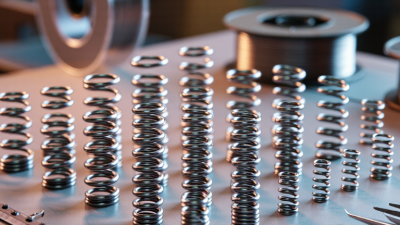
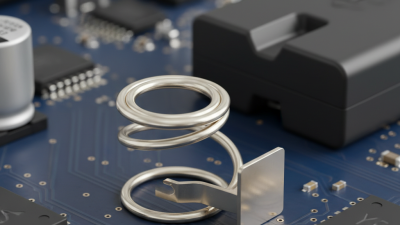
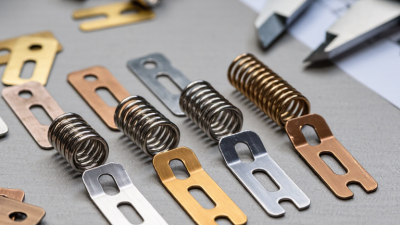
Picking the right battery contact spring? Yeah, it can make or break power stability, how fast the thing goes together, and even product safety. Honestly, a tiny spring can be the reason a device still starts reliably after thousands of battery swaps. Before signing off on a design, engineers will usually look at contact resistance, compression force, material, plating, and how much space they've got to work with.
So, the Battery Case Battery Contact Spring really has to line up with both the battery size and the way the housing is shaped—no guessing here. You'll want to check the installed height, the working stroke, and how far it can compress at most. If the spring's too soft, you might get spotty contact when things start vibrating. But if it's too stiff? That can wreck the battery terminal or even warp the plastic case. So, copper alloys, stainless steel, and nickel-plated options—each one gives you a different mix of conductivity, strength, and corrosion resistance. Nickel plating can be a real help in humid settings, sure, but it won’t fix a surface that wasn’t prepped properly in the first place.
Honestly? Real testing is what really matters. You've got to check voltage drop under load, watch how hot things get during continuous use, and make sure the contacts stay stable after repeated insertions. And test samples should also deal with vibration, dust, temperature swings, and sensible storage conditions. It's the little details that count.
Don't just go by the catalog dimensions. Once a spring gets plated, formed, or installed, its actual performance can shift—sometimes more than you'd expect. That's the tricky part: selection stops being so clear-cut. A spring can ace a bench test and still fail in a tight, crowded enclosure. So talk through the drawings with a qualified component manufacturer, and keep a record of your test results. That'll give you a lot more confidence. And honestly? The best choice isn't always the cheapest or the beefiest one. It’s the one that keeps dependable contact going under the product’s real operating conditions—you know, when it’s actually in use.
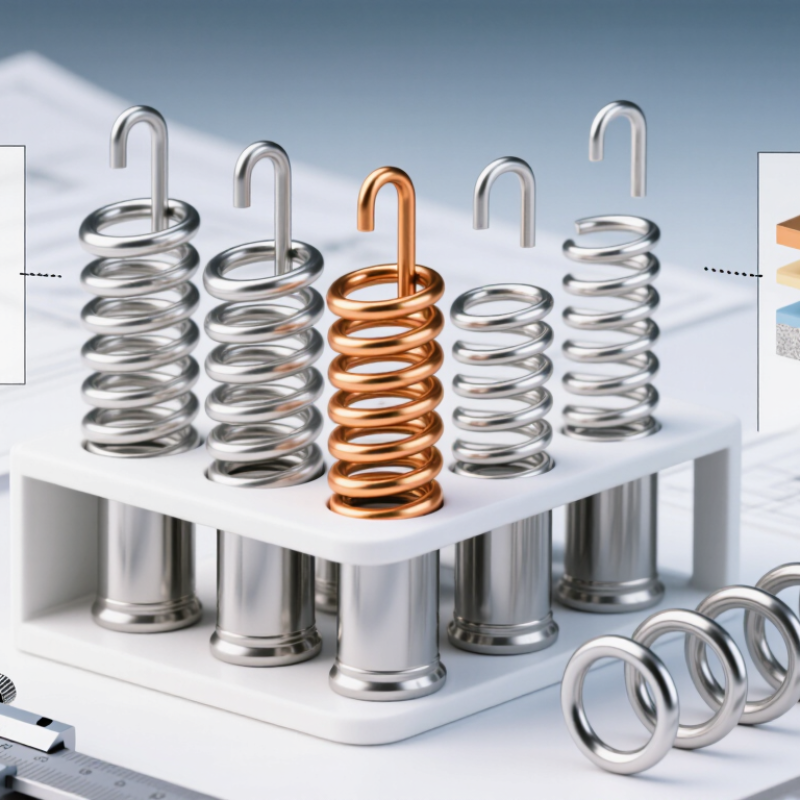
Understanding the Role of Battery Contact Springs
A Battery Contact Spring is a small part with a demanding job. It keeps steady electrical contact between a battery and its device, even when vibration or movement occurs. Its spring force also helps absorb small differences in battery length and terminal position. Without reliable contact, a device may flicker, restart, or lose power unexpectedly.
Material choice matters. Nickel-plated steel can offer useful conductivity and corrosion resistance, while stainless steel may provide stronger mechanical stability. The spring must fit the battery size without excessive pressure. Too little force creates intermittent contact. Too much force can damage the terminal or make battery removal difficult. In practical testing, I check contact resistance, compression height, and repeated insertion cycles. Real conditions can expose problems that a drawing misses. I have learned that a spring can look perfect and still perform poorly after wear.
Tips: Select a spring with stable force across its working range. Leave enough space for safe battery movement. Check the contact area for oxidation, sharp edges, and uneven plating. Test the assembly with fresh and partially discharged batteries. Heat is a warning sign. If the spring becomes warm during normal operation, review the resistance and pressure. Also, do not judge performance from one prototype. More testing is usually needed.
Identifying Battery Type, Size, and Contact Requirements
Choosing the right battery contact spring begins with identifying the battery accurately. Check its chemistry, nominal voltage, diameter, length, and terminal shape. A small size error can create weak pressure or damage the casing. Measure the battery compartment, not only the battery itself.
Consider the electrical load as well. A compact sensor may need only a light spring, while a motor-driven device can create higher current and vibration. The spring must maintain firm contact without compressing too deeply. Excessive force can shorten battery life or deform the holder. I usually test the contact with the actual battery, under cold and warm conditions. Temperature changes matter more than many design drawings suggest.
Material and surface finish also affect reliability.
Choose a spring with suitable conductivity, corrosion resistance, and fatigue strength. Confirm its allowable current and working deflection from technical data, rather than relying on appearance. Check polarity and keep the positive and negative contacts physically distinct. A simple continuity test helps, but it does not reveal every failure. Measure contact resistance during movement and after repeated battery insertion. I have seen a spring pass an initial test, then lose pressure after several hundred cycles. That result needs investigation, not excuses. A slightly longer spring may look safer, yet it can make installation awkward and stress the enclosure. Test the complete assembly before finalizing the contact design.
Comparing Spring Materials, Shapes, and Conductivity
How to Choose the Right Battery Contact Spring?
Material choice affects conductivity, spring life, corrosion resistance, and cost. Copper alloys usually conduct better than stainless steel. The Copper Development Association lists annealed copper at 100% IACS conductivity. Beryllium copper commonly ranges from about 20% to 70% IACS, depending on alloy and temper. Phosphor bronze conducts less, but it offers useful fatigue resistance and stable contact pressure. Stainless steel is mechanically strong, yet its conductivity is relatively low, often near 2% to 3% IACS. That difference matters in compact devices with limited contact force.
Shape changes performance. A cantilever spring suits simple battery holders and provides a clear wiping action during insertion. A U-shaped spring stores more travel in a small space. Crown contacts can distribute pressure across uneven battery surfaces, though their geometry is harder to inspect. Short springs feel firm, but they may lose contact when tolerances stack up. Longer springs absorb movement better. They can also fatigue sooner.
Plating deserves careful attention. Nickel improves surface durability, while tin can support lower contact resistance under suitable conditions. The exact result depends on thickness, force, humidity, and contamination. ASTM B117 salt-spray data can reveal corrosion behavior, but it cannot predict every field condition. I would not select a material from conductivity alone. Real testing should include insertion cycles, temperature changes, vibration, and milliohm measurements. Test results are often less elegant than catalog figures.
Choosing the Correct Spring Force and Compression Range
How to Choose the Right Battery Contact Spring?
Choosing the correct spring force and compression range is essential for stable battery contact. A spring that is too soft may lose contact during vibration. A spring that is too stiff can damage the battery holder or increase insertion force. Measure the available space carefully, including the spring’s free height and working height. Then identify the minimum force needed to maintain reliable contact. These values should match the spring’s operating range, not only its maximum capacity.
For a D Battery Contact Spring, begin with the battery length, terminal shape, and expected movement inside the compartment. Calculate the compression at full insertion and check the force at that point. Leave enough clearance before the spring reaches its solid height. This prevents permanent deformation during assembly. Real products may have dimensional variation. That gap matters. I have seen designs pass basic fitting checks but fail after repeated battery replacement.
Prototype testing provides stronger evidence than calculations alone. Measure contact resistance, insertion force, and spring recovery after repeated compression cycles. Test the assembly in its actual orientation. A spring may perform differently when sideways or partially supported. Stainless steel can offer useful corrosion resistance, while other spring materials may provide better fatigue performance. Select the material according to current, environment, and service life. A perfect calculation is not always a perfect fit. Review the results, adjust the force range, and test again.
How to Choose the Right Battery Contact Spring? - Choosing the Correct Spring Force and Compression Range
| Battery or Application |
Typical Contact Type |
Recommended Working Force per Contact |
Typical Working Compression |
Suggested Mechanical Reserve |
Selection Considerations |
AAA cylindrical cell
Portable electronics and compact devices |
Compression coil spring or leaf contact |
0.8–2.0 N |
1.0–2.5 mm |
0.5–1.0 mm before coil bind |
Use moderate force to maintain contact during vibration without making battery insertion unnecessarily difficult. |
AA cylindrical cell
General-purpose battery compartments |
Compression coil spring or formed spring contact |
1.0–3.0 N |
1.5–3.5 mm |
At least 20% of the available travel |
Allow for dimensional tolerance, temperature change, and gradual loss of spring force over service life. |
C or D cylindrical cell
High-capacity equipment and industrial devices |
Heavy-duty compression spring or dual contact |
2.0–6.0 N |
2.0–5.0 mm |
0.8–1.5 mm before solid height |
A larger spring can provide greater travel, but the housing must withstand the resulting compressive load. |
Coin or button cell
Low-profile watches, sensors, and memory devices |
Flat leaf spring or stamped contact |
0.2–1.0 N |
0.2–0.8 mm |
0.1–0.3 mm minimum |
Keep force low to avoid deforming the cell or damaging the holder; control sharp edges and surface finish carefully. |
9 V rectangular battery
Portable test equipment and consumer devices |
Leaf spring or snap-style terminal contact |
0.8–2.5 N |
0.5–1.5 mm |
0.2–0.5 mm minimum |
Prioritize secure retention and correct terminal alignment while avoiding excessive insertion force. |
Rechargeable cylindrical pack
Equipment exposed to vibration or shock |
Guided compression spring with secondary retention |
2.0–5.0 N |
2.0–4.0 mm |
At least 25% of total usable travel |
Use a separate mechanical restraint where possible; the spring should maintain electrical contact, not carry the entire shock load. |
Removable battery module
Frequent insertion and removal |
Low-friction leaf spring or guided coil spring |
1.0–3.5 N |
1.0–3.0 mm |
0.5 mm or 20% of travel |
Balance contact reliability against user insertion force and wear at the contact interface. |
Design reference: The recommended force and compression values are practical starting ranges rather than universal requirements. Final selection should be verified with the actual battery tolerance, contact resistance, vibration profile, temperature range, insertion-cycle requirement, and housing strength.
| Key Calculation |
Formula or Check |
Purpose |
| Spring rate |
k = ΔF ÷ Δx |
Confirms how much the contact force changes as the battery dimension varies. |
| Working force |
Fworking = Fpreload + kx |
Ensures the spring maintains adequate force at the minimum battery size and remains within the housing load limit at the maximum size. |
| Compression ratio |
Compression ratio = working deflection ÷ available deflection |
Helps prevent coil bind, overstress, and permanent deformation. |
| Contact resistance |
Measure at the intended current and after environmental testing |
Verifies that the selected force, contact geometry, plating, and surface condition provide stable electrical performance. |
Checking Fit, Polarity, Durability, and Safety
How to Choose the Right Battery Contact Spring?
A battery contact spring must fit the battery compartment, not merely touch the cell. Measure the battery diameter, length, and available compression space before selecting one. For an Aa Battery Contact Spring, check whether the spring keeps firm pressure without making battery removal difficult. I usually test several samples by inserting and removing batteries repeatedly. A loose spring causes intermittent power. An overly stiff spring can damage the holder or battery casing.
Polarity also deserves careful checking. Confirm which contact connects to the positive and negative terminals. The spring normally sits against the negative end, but the holder design can vary. Mark the wiring clearly during assembly. One small mistake can stop the device or create unsafe current flow. I once trusted a drawing without checking the physical prototype. That caused a reversed connection.
Durability depends on material, surface treatment, wire thickness, and operating conditions. Look for stable contact pressure after repeated compression cycles. Test the spring in humid and warm environments when possible. Watch for rust, discoloration, sharp edges, and excessive heat. The spring should handle the expected current without becoming hot. Add insulation where metal could touch nearby conductors. A checklist helps, but it is not perfect. Real testing may reveal weak points that specifications miss. Recheck the fit after vibration, drops, and long storage.
How to Choose the Right Battery Contact Spring?
Checking fit, polarity, durability, and safety starts with the spring material. The chart compares typical midpoint values for electrical resistivity and tensile strength commonly published for spring-contact materials.
Lower electrical resistivity generally supports lower contact losses, while higher tensile strength can improve resistance to permanent deformation. Stainless steel is corrosion-resistant but less conductive. Music wire provides high strength but relatively poor conductivity. Phosphor bronze and beryllium copper offer a stronger balance of conductivity and spring performance. Always verify the compressed height, contact force, polarity orientation, plating, temperature range, and applicable safety requirements for the final design.
Testing the Selected Battery Contact Spring in Use
Selecting a battery contact spring is only half the task. The real test begins inside the finished device. A Toy Battery Contact Spring may look simple, yet small changes in force can affect power stability. I check the spring after assembly, not only on a workbench. It must hold the battery firmly without marking its casing. Too much pressure can damage thin compartments. Too little pressure can create intermittent contact.
During testing, I measure contact resistance before and after repeated insertion cycles. A milliohm meter helps reveal losses that a basic continuity check misses. I also record voltage drop while the device operates under its highest expected load. The spring should remain stable during startup, movement, and low-battery conditions. Then, I expose samples to heat, humidity, and vibration. Watch the contact point closely. Darkening, loosened coils, or uneven compression can signal early failure. In one trial, the spring passed static testing but lost contact after repeated drops. That result changed my approval criteria.
Use production-like batteries and housings during final validation. Small dimensional differences matter. Inspect several samples from different batches, because one good part proves little. I also review the force curve after testing, rather than trusting appearance alone. A spring can recover visually while losing useful resilience. Some tests may feel excessive for a simple compartment. They are not. Still, my process is not perfect; humidity exposure may not represent every home. That limitation should be documented and tested again when field feedback appears.
How China Suppliers’ Automated Factories Produce Reliable Bridge-Riveted AA Battery Connectors
China’s automated factories are reshaping the production of bridge-riveted AA battery connectors, where consistency, corrosion resistance, and assembly efficiency are essential. The International Energy Agency reported in *Global EV Outlook 2024* that worldwide battery demand exceeded 750 GWh in 2023, reflecting the broader industry’s growing dependence on reliable electrical contact components. Although AA batteries serve smaller devices, the same manufacturing principles apply: stable geometry, repeatable joining, and tightly controlled material quality.
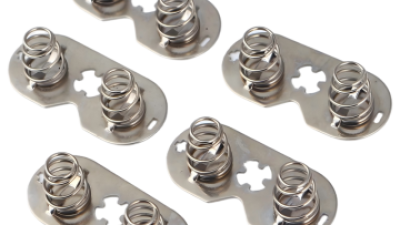
Our battery contact springs are produced through a fully automated process capable of exceeding 2 million sets per day. Automated stamping and inspection help maintain exceptional verticality and flatness, improving solderability and reducing variation during downstream assembly. Bridge riveting secures each spring firmly to the connector structure, minimizing loosening caused by vibration or repeated battery replacement. These features support dependable current transfer in household electronics, controls, toys, and portable equipment.
Reliability is verified through disciplined quality control rather than visual inspection alone. Each spring is manufactured to consistent dimensions and tested for surface durability, including a 24-hour neutral salt spray test. This approach aligns with the performance-focused requirements reflected in the IEC 60086 battery standards, which emphasize dependable electrical connection and safe battery use. For buyers seeking scalable supply, precise riveting, and stable performance, an automated Chinese manufacturing line offers a practical solution for high-volume AA connector production.
FAQS
Measure battery chemistry, voltage, diameter, length, and terminal shape. Measure the compartment too. Small errors can weaken contact or damage the casing.
Use enough force to maintain contact during movement and vibration. Excessive force can increase insertion effort and deform the holder. The perfect value may need testing.
Measure its free height and working height inside the compartment. Leave clearance before the spring reaches solid height. This reduces permanent deformation during assembly.
Real batteries have dimensional variation. Test insertion, removal, vibration, and temperature changes. A drawing may look correct but still fail.
Perform a continuity test, then measure contact resistance during movement. Repeat the measurement after several hundred insertion cycles. Initial success proves very little.
Confirm the positive and negative terminals physically. Mark the wiring clearly during assembly. Do not rely on memory. A reversed connection can stop the device.
Select materials for conductivity, corrosion resistance, fatigue strength, and expected current. Check technical data instead of judging appearance. Warm metal deserves attention.
Look for rust, discoloration, sharp edges, heat, and lost spring pressure. Test humid and warm conditions when practical. Recheck the holder after vibration, drops, and storage. A checklist can miss weak points.
Conclusion
Choosing the right Battery Contact Spring is essential for creating a stable, safe, and efficient connection between a battery and its device. Begin by identifying the battery’s chemistry, size, shape, terminal layout, and contact requirements. These details determine the spring’s suitable dimensions, configuration, polarity arrangement, and mounting position. Next, compare available materials and shapes, considering conductivity, corrosion resistance, flexibility, and long-term durability. The selected material should support reliable current transfer while maintaining performance under repeated use.
Spring force and compression range are equally important. A spring that is too weak may cause intermittent contact, while excessive force can damage the battery or housing. Confirm that the spring fits securely, maintains correct polarity, and operates safely within the expected temperature and usage conditions. Finally, test the Battery Contact Spring in the actual application by checking electrical continuity, voltage stability, mechanical movement, resistance to vibration, and performance over repeated battery insertions. Careful evaluation helps ensure dependable operation and a longer service life.