Leave Your Message
You know, when you're building compact electronics, there's barely any room for error—especially when it comes to connections. Think about a tiny sensor or a wearable device: that little contact point is constantly dealing with vibrations, movement, and the whole tight-assembly puzzle. And honestly, getting it wrong can be a nightmare. That's why reliable components really matter. Just look at the numbers—the World Semiconductor Trade Statistics released their Fall 2024 forecast, and they're projecting global semiconductor sales to hit $627.6 billion this year, and then climb to $697.2 billion by 2025. So yeah, the stakes are pretty high. So, the International Energy Agency released their Global EV Outlook 2024, and they're predicting that electric car sales might hit around 17 million this year. Now, these numbers don't exactly tell us about the demand we're seeing this spring, but they do give us a sense of just how huge and complicated the whole electronic products scene has become.
Now, an Electronic Spring - yeah, it might seem like a tiny thing - but it's actually pretty clever. It maintains contact pressure while also giving a bit of wiggle room for movement and any slight dimensional changes. In connectors or battery contacts, that's crucial for keeping a stable electrical path, assuming the design, material, plating, and operating conditions are all matched up correctly. So it's a small part, but it definitely pulls its weight. When you're working on a product, the choice you make can really shake things up—how much space you need for assembly, how long the thing lasts, and even what checks you have to run. But hey, a spring isn't some magic fix. If the shape's off, the material's wrong, or you skip proper testing, you're still going to face contact headaches down the line. So, before you commit to production, you really need to test the thing under realistic conditions—think actual loads, temperature swings, vibration, and how many cycles it'll see. Honestly, that's a step people skip all the time, and it comes back to bite them. The bottom line is, the right spring for your product isn't about some flashy spec sheet number; it's about what fits your specific situation and actually works in the real world.
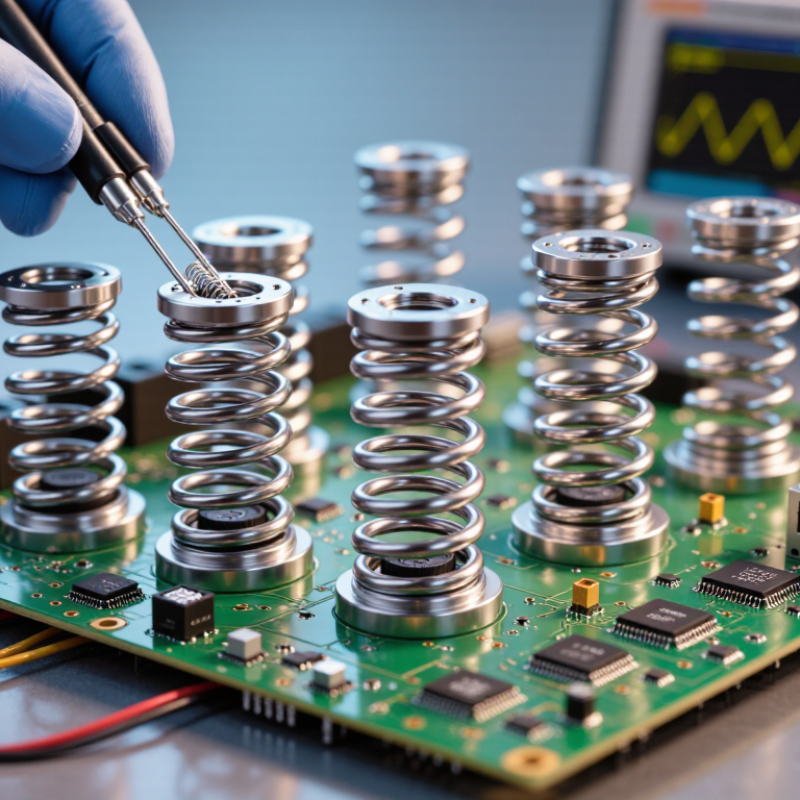
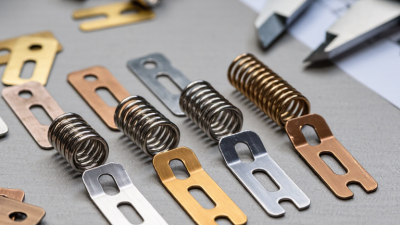
Electronic springs are conductive spring elements that press two parts together and carry current across their contact point. They may sit inside a battery compartment, a compact connector, or a small switch. Their shape provides both mechanical pressure and an electrical path. One part does two jobs.
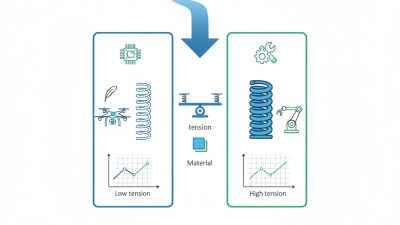
When compressed, a spring pushes against a mating surface. Enough contact force helps maintain a stable connection despite vibration or slight movement. Too little force can cause intermittent contact; too much may deform the spring or wear the surface. The useful range depends on material, shape, travel, and assembly tolerances. It is easy to underestimate those details.
Electrical performance also depends on the surfaces touching. Oxidation, dust, and uneven plating can increase resistance, even when the spring feels firm. A spring contact should be assessed in the actual circuit, with its expected current, temperature, and environment. A quick continuity check is helpful, but it may miss changes under vibration. That matters.
Designers often test several compression levels and inspect the contact after repeated cycles. A spring that works on a clean bench may behave differently inside a warm, tightly packed product. That is not a failure of the concept; it is a reminder that force and conductivity must be designed together. A little uncertainty remains until the assembled product is tested.
| Spring or contact style | Common conductive material | Typical conductivity reference | Contact force and circuit function | Useful design consideration |
|---|---|---|---|---|
| Leaf or cantilever contact | Phosphor bronze | Often approximately 10–15% IACS, depending on alloy and condition | Flexes against a mating surface to maintain an electrical path; force depends on dimensions, deflection, and material condition. | Useful where a compliant, repeatable contact is needed. Avoid excessive deflection that can cause permanent set or fatigue. |
| Stamped spring contact | Beryllium copper (copper-beryllium alloy) | Common grades are roughly 20–30% IACS; grade and temper affect the value | Provides spring pressure while carrying current between conductive parts; contact force is set by the component design. | Combines useful spring properties with electrical conductivity. Material selection and manufacturing controls should account for beryllium-related safety requirements. |
| Spring contact or connector element | Copper alloy, such as brass or phosphor bronze | Varies by alloy; copper alloys generally conduct less well than pure copper | Applies contact force to help keep a circuit closed despite small movement or tolerance variation. | A conductive finish may be selected to suit wear, corrosion, and contact-resistance needs; plating does not replace correct spring-force design. |
| Stainless-steel spring contact | Spring-temper stainless steel | Typically only a few percent of IACS; exact conductivity depends on grade and condition | Can provide mechanical spring action; electrical performance may require a conductive contact surface or a different material. | Consider when corrosion resistance or mechanical characteristics are priorities, and verify resistance and temperature rise in the assembled circuit. |
| Coil spring used in a conductive assembly | Conductive copper alloy or plated spring material, as appropriate to the design | Depends on the selected alloy, plating, geometry, and current path | Can provide restoring force and, in a designed contact path, conduct current between components. | Do not assume every mechanical coil spring is an electrical contact; confirm the current path, contact points, and resistance. |
| Gold-plated spring contact | Copper-alloy spring with a suitable contact finish | Bulk conductivity is determined mainly by the base spring alloy; the finish affects the contact interface | Spring force maintains physical contact; the surface finish can support stable electrical contact in suitable applications. | Choose finish thickness and any underlayer for the expected wear, environment, and mating surface; gold does not eliminate the need for correct force. |
Note: IACS means International Annealed Copper Standard, with annealed copper defined as 100% IACS at 20°C. Conductivity figures are indicative material references, not guaranteed values for every grade or temper. There is no single standard contact-force value for an electronic spring: force depends on geometry, material, working deflection, tolerances, and the application.
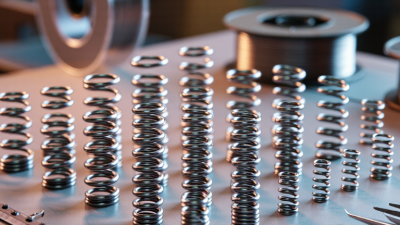
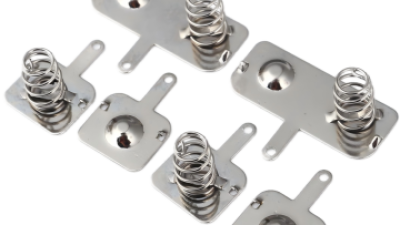
Fully automated production plays a vital role in making AA battery connectors consistent and dependable. In our factory in China, precision equipment forms and assembles universal battery contact springs, while advanced bridge riveting creates a firm connection between components. This controlled process helps prevent loose or detached springs, supporting stable contact with the battery and reliable performance in the finished device. Automated inspection and repeatable production settings also help maintain consistent quality across large orders.
With daily output exceeding two million sets, the factory can serve high-volume requirements without compromising precision. Each spring is made with careful attention to flatness and verticality, helping it fit correctly and deliver excellent soldering performance during assembly. Products have also passed rigorous 24-hour salt spray testing, demonstrating resistance to corrosive conditions. By combining automated manufacturing, secure riveting, and quality-focused inspection, our production process supports durable AA battery connectors for a wide range of applications.
A curved beam or raised contact flexes when parts meet, then presses back against the mating surface. That restoring force helps maintain contact. Fit matters.
Beam length, thickness, and bend shape influence travel and force. A longer, gently curved beam may deflect more gradually than a short, stiff one. Small changes matter.
Check the spring’s working travel, not only its resting height. Allow for assembly tolerances, then measure force across the intended movement. A drawing may not tell the whole story.
No. It is a comparison point, not a universal guarantee. Current capacity depends on contact size, metal, plating, heat release, and operating conditions.
Confirm whether the rating covers continuous current or a short pulse. Measure voltage drop and temperature in the assembled device. A sealed enclosure may trap heat.
Check available space, working height, and contact force. Sweat, skin oils, and wrist movement can affect the surrounding interface. Test realistic prototypes.
Vibration, temperature changes, and tight installation space can affect performance. Choose materials and finishes for the expected load and environment, then verify them in testing.
They can touch a test pad as a board is positioned, then release for the next unit. Track alignment, resistance, and wear over many cycles. Fixtures may need cleaning.
Not necessarily. A stiffer spring may make battery insertion harder or strain its mounting point. Compare the rating with actual operating peaks, and check how shared loads divide. Reconsider assumptions.
An Electronic Spring is a conductive contact designed to maintain an electrical connection while accommodating movement and repeated assembly. Its spring-shaped geometry applies contact force, helping keep components connected as they shift or vibrate. When selecting one, consider the current rating, contact resistance, dimensions, and operating conditions; typical current capacity may range from 0.5 to 5 A per contact, depending on the design.
Durability is also important. A rating of 10,000 or more mating cycles can help indicate how well a contact may withstand repeated connection and disconnection, though actual performance depends on use and environment. Gold plating can support stable, low-resistance connections over repeated cycles. These features make electronic springs useful in compact devices such as wearables, automotive electronics, and test fixtures, where dependable contact, limited space, and repeated movement are common considerations.